
HOW IT PLAYS.
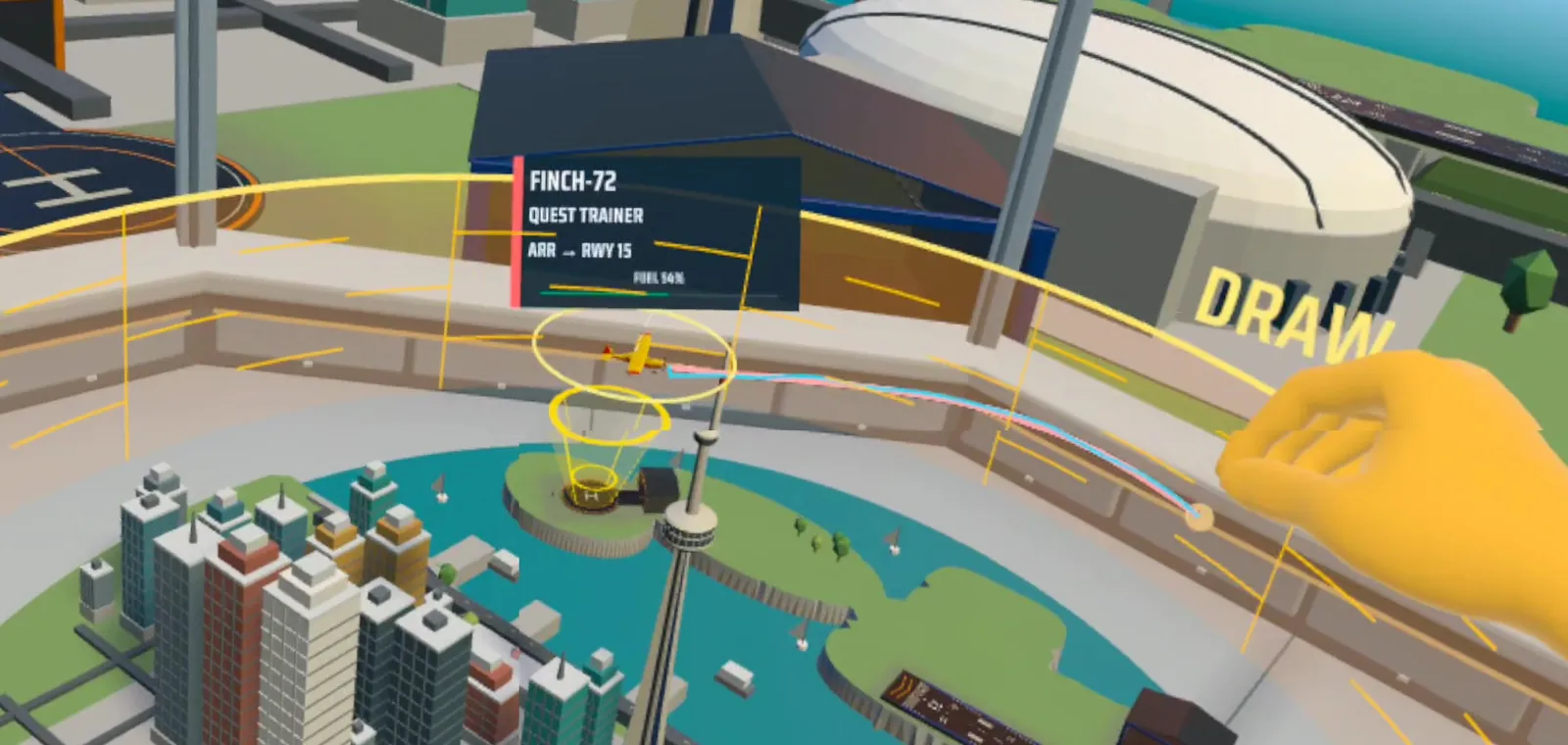
Vector Tango is a mixed reality air traffic control game for Meta Quest. A miniature airport sits on your real table, and every plane flies the path you draw. This page explains what you do in a shift, what is real about it, and what the game simplifies.
Your job in a shift
Flights arrive at the edge of the board. You draw a line from each plane, and the plane flies it. You have three kinds of landing sites:
- RED runway for small planes: single props, turboprops, business jets, the crop duster and the cargo twin.
- BLUE runway for jets: the airliner and the regional jet.
- YELLOW pad for helicopters.
Departures take off and must leave through their exit gate. Flyovers cross the sky and leave. Circuit planes fly through a ring and come back to land. You route nine of the game's eleven aircraft types; a fighter jet patrols military airspace, and a demonstration jet waits in the Hangar. Twelve voiced pilots call you on the radio.
In the Campaign, a crash or the end of the shift timer fails the shift. In Competitive, only a crash ends the run. Clean routes, no close calls and accurate landings earn up to five stars. See exactly how the scoring works.
What makes a shift hard
- Low fuel. A plane in a fuel emergency must land first, or it glides down.
- Priority cargo. In the Campaign, no other plane may land while the cargo plane is in the air.
- Military airspace. A red zone opens. Keep traffic out of it. Leave a plane inside too long and a fighter jet comes after it.
- Weather. Storm banks push planes off their route. Night and fog make the board harder to read. Competitive turns the time of day every level and the weather every two levels.
- Speed. In Competitive, planes get faster, up to 1.6 times, and the guides fade away level by level.
- Busy runways. A plane that lands on a busy runway must go around.
What is real, and what we simplify
Vector Tango is a game inspired by real air traffic control. It is not a simulator of controller procedures.
Real
- Controllers keep aircraft apart, sequence arrivals and departures, and give priority to emergencies such as low fuel.
- They work around restricted military airspace and route traffic around weather.
- The five airports are real places in Ontario, Canada, each with its own character. See the airports page.
Simplified
- Real controllers talk to pilots with spoken clearances, headings and altitudes, and follow separation rules in miles and feet. In Vector Tango you draw each path, and the plane flies it.
- Runway colours, rings and exit gates are game rules.
- The maps are miniature interpretations of the airports, not exact-scale copies.
- Two of the five real airports have no control tower. Niagara District is uncontrolled, and North Bay has a NAV CANADA flight service station. The game gives every airport a tower.
- Real work is split between airport towers, terminal control and area control centres. In the game you handle all of it from one desk.
The Campaign follows a controller's career, inspired by my father Frank. As the game says: career journey inspired by life; dialogue and gameplay are dramatized.
Words you will hear in the game
Short definitions of air traffic control terms as Vector Tango uses them. For official definitions, see the FAA Pilot/Controller Glossary.
- Vector
- A heading a controller gives a pilot to steer the aircraft. Controllers say they vector traffic. In Vector Tango you draw the vector as a line.
- Final approach
- The last straight leg to the runway. The landing cone in the game shows where a plane must line up to land.
- Go-around
- An aborted landing. The pilot climbs away and tries again. In the game, a plane that lands on a busy runway goes around, and it counts as a near miss.
- Separation
- The safe distance controllers keep between aircraft. A near miss in the game means two planes got too close.
- Handoff
- Passing an aircraft to the next controller. In the game, a plane that leaves your airspace anywhere except its exit gate is a missed handoff.
- Overflight
- Traffic that crosses your airspace without landing. North Bay teaches it in the Campaign.
- Circuit
- A loop around the airport and back to land. In the game, a circuit plane flies through a ring and returns.
- Mayday and low fuel
- A plane low on fuel must land first. If it waits too long, it glides down.
- Restricted airspace
- Airspace closed to normal traffic, for example for military use. The red zones in the game are restricted airspace.
- Flight strip
- A strip of paper or a screen entry that tracks one flight. The control desk in the game has flight strips.
Ways to play
- Campaign. Twenty-five shifts across five Ontario airports, from Niagara to Toronto. John, your instructor, talks you through every new idea.
- Competitive. An endless run at any airport. Every ten safe flights adds a new rule, up to level 24. Each airport has its own leaderboard.
- Sandbox. Place runways and a helipad, pick a tower, and set the traffic, weather and time of day, on your table or across your whole room.
Play in mixed reality on your own table, or flip one switch to stand in a VR control tower and watch the planes land outside the window. Use hand tracking, Quest controllers or the Logitech MX Ink pen. In your first game, a ghost hand shows you each move.
Vector Tango is coming to the Meta Horizon Store in October 2026. The beta is open now, and beta testers get the game free at launch.
Vector Tango is a game. It is not affiliated with or endorsed by NAV CANADA, Transport Canada, the FAA or any airport named on this page.